Volusion vs Shopify: Direct Comparison 2026
Volusion vs Shopify in direct comparison. Costs, checkout, app ecosystem and future-proofing. Find out which platform fits your store.

Richard Roth
SEO & GEO Strategist
July 21, 2026
7 min read
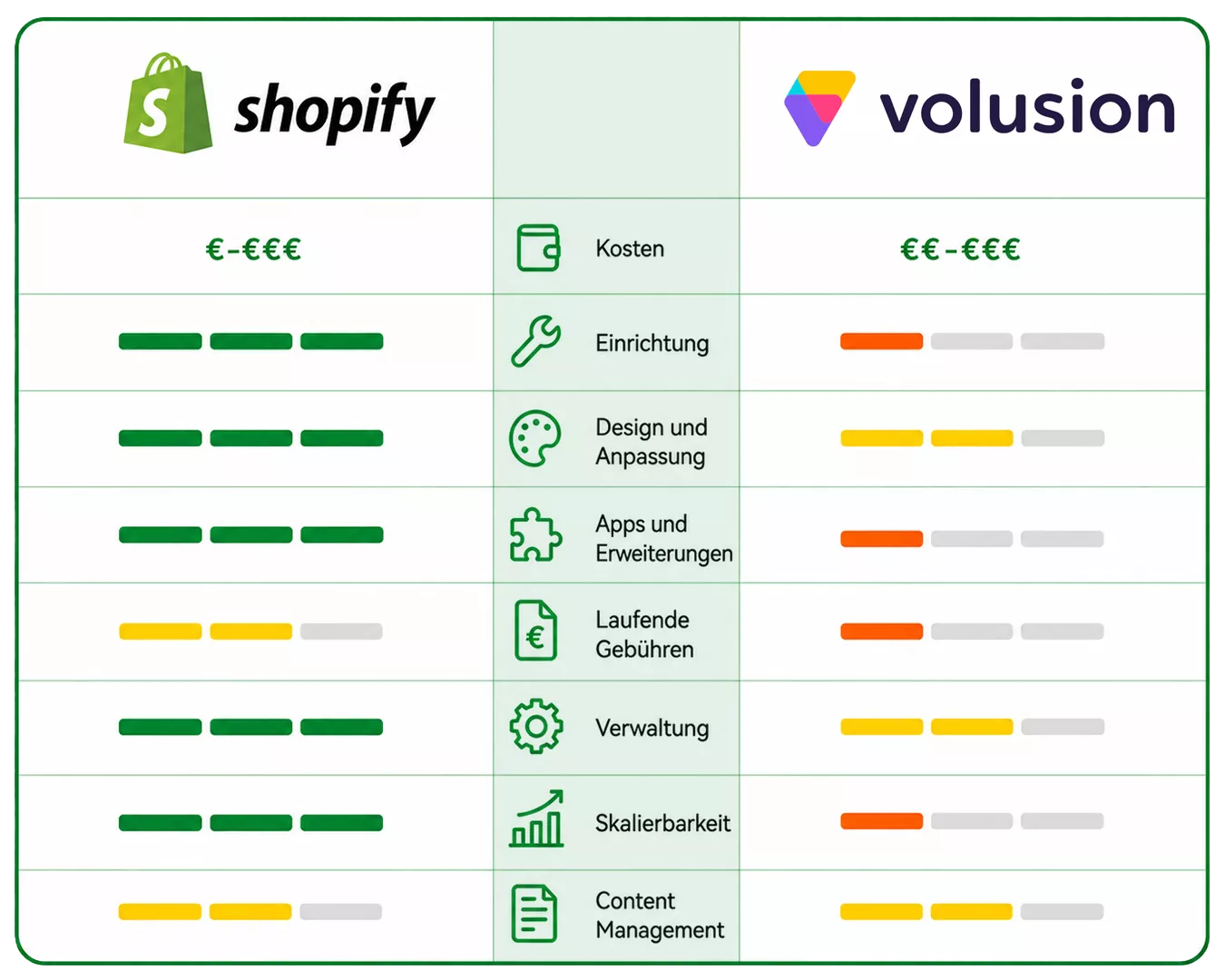
You’re facing a decision: Volusion or Shopify? Both are hosted SaaS shop systems, but Volusion is now considered dated, while Shopify is continuously evolving. We compare both from practical experience and show you what really matters in the decision. For an overview of more systems, check out our shop system comparison.
- • Volusion is a hosted SaaS shop system and was a solid choice for a long time, but is now considered technically dated with a limited ecosystem.
- • Shopify is also hosted, but is continuously evolving and offers the best-converting checkout and the largest app ecosystem.
- • On checkout, app ecosystem, and content features, Shopify clearly leads.
- • For growing shops, Shopify is usually the more future-proof platform.
Shopify and Volusion: modern versus matured SaaS platform
Both platforms are hosted: you don’t have to worry about servers, updates, or security with either. The difference is in the maturity and the pace of development.
Volusion was one of the pioneers in hosted e-commerce and a solid solution for years. Many existing shops still run stably on it today. But the platform is considered technically matured: a dated admin, a weaker checkout, a small app ecosystem, and little visible development.
Shopify continuously invests in checkout, storefront technology, and ecosystem. For merchants who want to grow and sell in a modern way, this pace is a real advantage, because new features arrive regularly without you having to do anything.
With Volusion the real cost isn’t the monthly plan, it’s the standstill. When a checkout and feature set stop evolving, you quietly lose conversions to competitors who ship new payment methods and speed improvements every quarter. One thing to plan for on this migration: those old ProductDetails.asp URLs need a proper redirect map, otherwise you hand back the rankings you built over the years.
Cost comparison: what do you really pay?
Both work with predictable monthly prices but differ in the details.
Volusion costs
Volusion offers tiered monthly plans based partly on your number of products. One plus: Volusion charges no transaction fees. The plans themselves are cheap.
The catch is less in the price than in what you get for it: a dated base, limited content features, and a small ecosystem that gives you little room as you grow.
Shopify costs
Shopify works with a clear pricing model. The Basic plan costs about €36 per month with annual billing, higher plans are about €105 and €384. Included are hosting, SSL, support, and the full feature scope.
With Shopify Payments you pay no platform transaction fee. For a similar price you get a modern, continuously evolving platform.
Cost comparison in practice
| Cost type | Volusion | Shopify (Basic) |
|---|---|---|
| Monthly plan | tiered, product-limited | ~€36/month |
| Transaction fee | none | 0% with Shopify Payments |
| Checkout & conversion | dated | best-converting (Shop Pay) |
| App ecosystem | small | over 16,000 apps |
| Development | slow | continuous |
Comparing with Volusion is rarely about price but about future-proofing. Factor in that a stagnating platform costs you revenue long term because checkout and features don’t keep pace with the market.
Checkout, conversion, and app ecosystem
In the end the checkout decides your revenue, and here lies one of the biggest differences.
Shopify’s Shop Pay is considered one of the best-converting checkouts in e-commerce, with saved data and recognition across the entire Shopify network. The Volusion checkout, by contrast, feels dated and doesn’t reach the same conversion.
On the app ecosystem too, the gap is large: Shopify offers over 16,000 apps for practically every use case, Volusion only a small offering. If you need a specific feature, you usually find it immediately with Shopify, with Volusion often not at all.
Future-proofing: how does Volusion stand?
This is the actual core of the decision. Volusion works for existing shops, but the platform doesn’t keep pace with the large SaaS providers on the speed of development.
For a shop that wants to grow, that’s a risk: new payment methods, modern checkout standards, better performance, and marketing integrations arrive more slowly or not at all with a stagnating platform. This standstill shows in the market data too: our market share analysis recorded the steepest decline of all tracked systems for Volusion at -38.8% between 2024 and 2026, while Shopify grew by 20.9%. Shopify delivers exactly this innovation continuously, without you having to worry about it. That’s why Shopify is usually the more future-proof choice for growing shops.
SEO and legacy URLs
Both platforms offer the SEO fundamentals, but Volusion with limited fields and a weaker content system.
An important point when switching: Volusion uses its own technical URL structure (for example ProductDetails.asp). Since you keep your own domain, we capture each of these legacy URLs, map them to the matching Shopify counterpart, and set clean 301 redirects. This way your rankings are preserved.
When is Volusion the better choice?
Volusion makes sense if you:
- Run an existing, stable shop that currently meets all requirements
- Have no aggressive growth plans
- Get by with the existing features and need few apps
- Don’t want to invest effort in a switch
For a running shop without growth pressure, Volusion may be enough for now.
When is Shopify the better choice?
Shopify makes sense if you:
- Want a modern, future-proof platform
- Prioritize the best-converting checkout and higher conversion
- Depend on the largest app ecosystem and more payment methods
- Want to grow, sell internationally, or serve multiple channels
- Need strong content and SEO features
Shopify is the better choice as soon as growth and future-proofing are the priority.
Switching from Volusion to Shopify
Maybe you already use Volusion and notice the platform is holding you back, whether at the checkout, with missing apps, or with content features. Switching to Shopify is then a logical step into a modern future.
The migration from Volusion to Shopify transfers products, options, customers, orders, and content. We rebuild your design as a fast Shopify theme, capture your legacy URLs completely, and redirect them via 301 so your rankings are preserved.
With the right concept, you use the migration as an opportunity: out of a dated platform, into modern technology with the best-converting checkout. We at Store2x specialize in exactly these migrations to Shopify. If you’re considering whether a switch makes sense for you, you can request a free potential analysis.
Conclusion
Volusion or Shopify? Volusion was a solid platform and works for existing shops. But if you want to grow and sell in a modern way, the better checkout, the larger ecosystem, and the continuous development clearly speak for Shopify. For most growing shops, Shopify is the more future-proof choice.
 Frequently Asked Questions
 Is Volusion still a good choice?
How are my old Volusion URLs redirected?
Will my rankings be preserved when switching to Shopify?
Does Shopify, like Volusion, have no transaction fees?
How long does the migration from Volusion to Shopify take?
You might also like
OXID vs Shopify: Direct Comparison 2026
OXID vs Shopify in direct comparison. Costs, B2B, hosting and maintenance. Find out which shop system fits your store.
OpenCart vs Shopify: Direct Comparison 2026
OpenCart vs Shopify in direct comparison. Costs, hosting, extensions and maintenance. Find out which shop system fits your store.
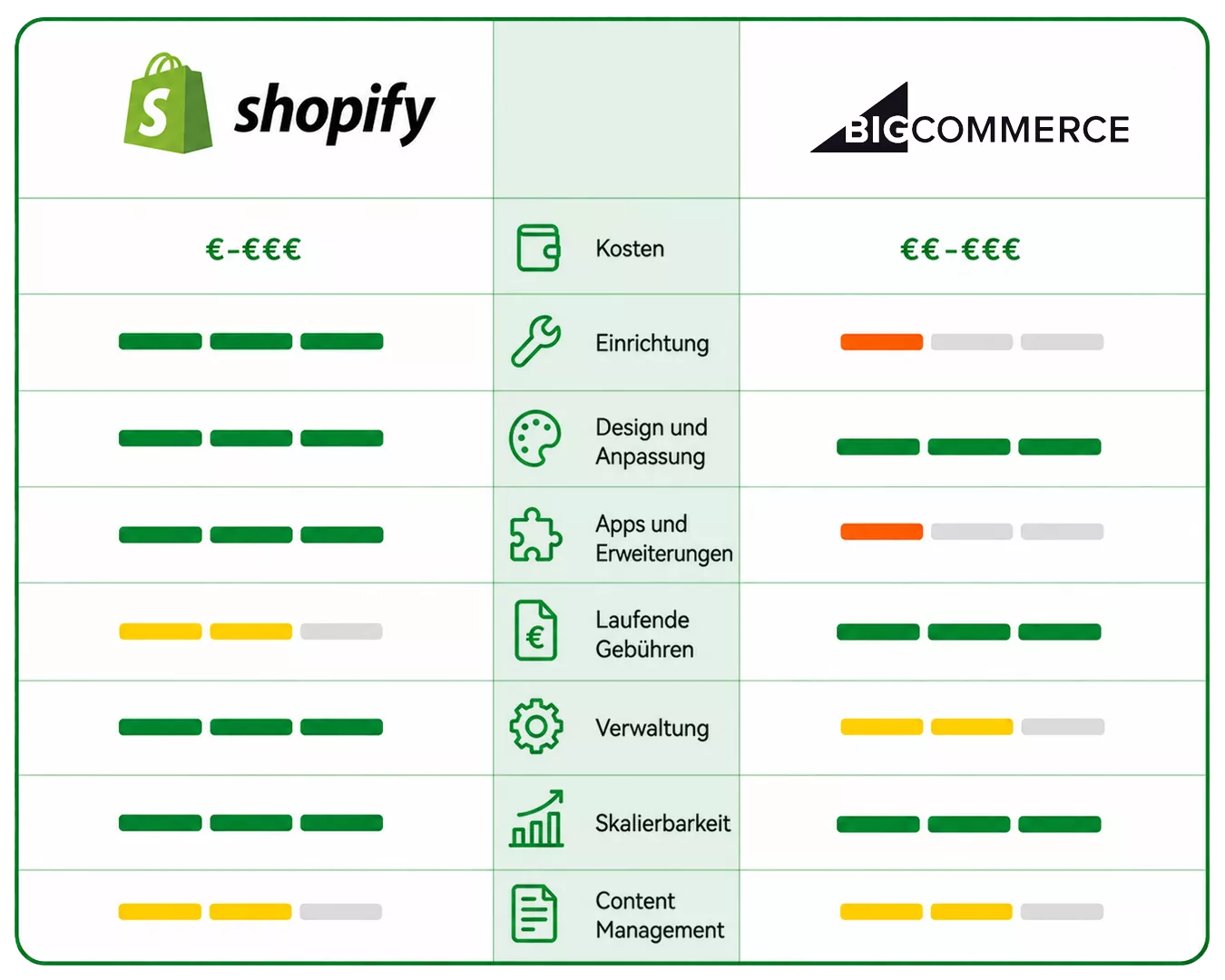
BigCommerce vs Shopify: Direct Comparison 2026
BigCommerce vs Shopify in direct comparison. Costs, plan upgrades, checkout and app ecosystem. Find out which SaaS platform fits your store.