Shopware Alternatives 2026: Live Faster, Stable Operations, Predictable Costs
Shopware alternatives compared: without expensive major upgrades or hosting and maintenance load, but live faster. Which system suits which shop.

Richard Roth
SEO & GEO Strategist
June 28, 2026
11 min read
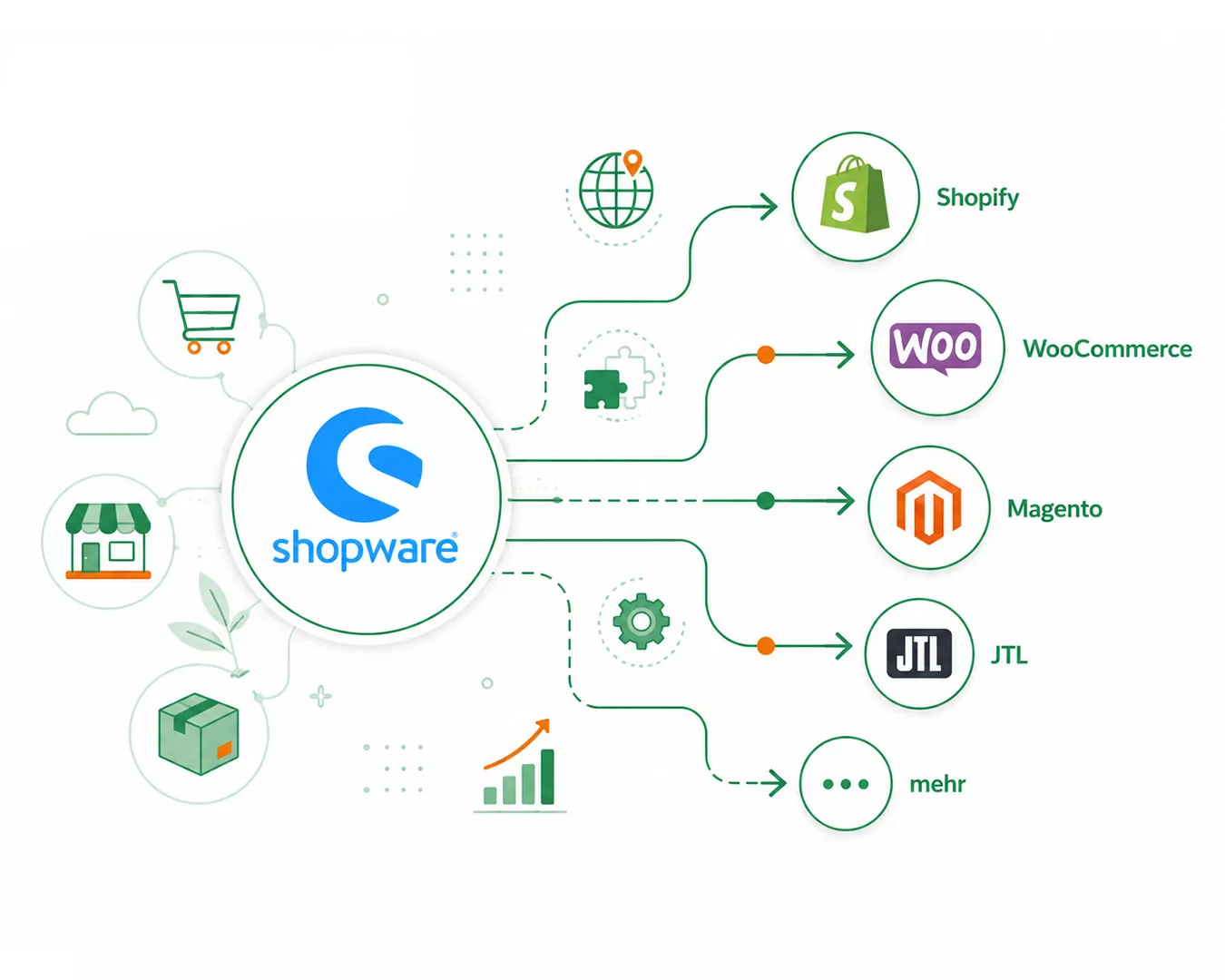
Shopware is a strong system. But every major update ties up developer time again, the hosting runs on your bill, and for every tweak you often need the agency. No surprise that many merchants look for an alternative that grows with them without constant maintenance.
The choice is bigger than many think, but far from every alternative fits a Shopware shop. Here are the serious options, their strengths and weaknesses and which system pays off for whom.
- • Shopify is the most obvious alternative for most Shopware shops: hosted, maintenance-free, from 36 euros a month and live fast.
- • Adobe Commerce (Magento) stays the pick if you run very large, highly custom B2B with your own dev team. Shopify doesn't win here automatically.
- • BigCommerce and WooCommerce make sense depending on your profile: BigCommerce as SaaS with many native features, WooCommerce for content-driven WordPress shops.
- • Peer level matters: for a mid-market system like Shopware we only compare serious platforms. Website builders like Wix or Jimdo aren't in the same league.
- • Shopware's strength remains customizable B2B in the mid-market. The question is whether that depth is worth the high operating effort to you.
Why do merchants look for a Shopware alternative?
Most don’t switch because Shopware is bad, but because the ongoing effort gets too big. Shopware is self-hosted and open source. That means you’re responsible for hosting, security and updates yourself, usually with an agency at your side.
Four reasons come up again and again in practice:
- Costly major upgrades: every bigger version jump is a project with developer time and budget, not a click.
- Hosting and maintenance load: servers, caching and performance tuning stay your problem permanently.
- Technical hurdle: Shopware is powerful, but for every change you often need developers instead of doing it yourself.
- Longer time to market: from idea to go-live takes more time than on a fully hosted platform.
The bottom line: the Community Edition is free, but the total operation of hosting, agency and upgrades is expensive. So it pays to look at the alternatives. The wider market backs this up: our shop system market share analysis shows hosted platforms like Shopify gaining ground while several self-hosted systems consolidate.

When I sit with teams weighing a Shopware move, the deciding factor is rarely a missing feature, it’s who’s on the hook when the next major upgrade lands. On Shopware that upgrade is a scheduled project; on a hosted platform it just happens overnight. Be honest about your in-house dev capacity: if the answer is “our agency handles all of it,” you’re already paying the premium that a SaaS platform removes.
What does a good Shopware alternative need to deliver?
A real alternative has to deliver where Shopware costs you time or money, without losing substance. Judge every candidate on the same six criteria:
- Total cost: not just the license, but hosting, maintenance and agency combined.
- Scalability: does the platform keep up with growth and traffic peaks?
- Ease of use: how much can you do yourself without a developer?
- Maintenance effort: who handles updates, security and operations?
- Content and SEO: is the CMS enough for your content and do your rankings survive?
- Time to market: how fast are you live and able to ship changes?
Everything below hangs on this grid.
The best Shopware alternatives at a glance
For a mid-market and B2B system like Shopware, only platforms at the same level qualify. These five are the relevant candidates:
| Platform | Type | From price/month | Hosting | Best for |
|---|---|---|---|---|
| Shopify | SaaS (hosted) | from 36 € | included | Fast, scalable D2C and B2B shops without maintenance load |
| Adobe Commerce (Magento) | Self-hosted / PaaS | high license/year | self | Large, highly custom enterprise B2B with an in-house dev team |
| BigCommerce | SaaS (hosted) | from ~29 € | included | SaaS fans who want many native B2B features |
| WooCommerce | Self-hosted (WordPress) | from hosting cost | self | Content-driven shops already on WordPress |
| OXID / Spryker | Self-hosted / Composable | high license | self | Very custom DACH B2B and composable commerce |
You won’t find website builders like Wix or Jimdo here on purpose. For a Shopware shop they’d be a step back, not an equal replacement.
The alternatives in detail
Shopify: the obvious move
Shopify is a SaaS platform, software as a service. Hosting, updates and security are included in the monthly price, you don’t have to handle any of it. That solves the biggest Shopware pains in one go.
Strengths:
- No more costly major upgrades. Shopware version jumps tie up developer time, Shopify updates automatically with no project effort.
- Ship faster. Changes go live without a developer bottleneck instead of booking the agency for every tweak.
- Budget from tech to growth. Less money on maintenance and operations means more for marketing and conversion.
Where the limits are: for very deep, custom backend processes Shopware is more flexible. But you get most of that flexibility back on Shopify through the app ecosystem with over 16,000 apps plus custom apps. For real B2B there is Shopify Plus with wholesale channels and customer groups.
Best for: most Shopware shops that want speed, stability and predictable costs.
Before you switch, a sober cost comparison pays off. Our ecommerce platform calculator shows you in a few minutes what Shopware costs you in total operation and where Shopify saves.
Adobe Commerce (Magento): the enterprise heavyweight
Adobe Commerce, formerly Magento, is the classic choice for very large, highly custom shops. The platform is extremely powerful and hard to beat in complex B2B.
- Strength: maximum depth for custom enterprise processes and large B2B.
- Weakness: license, infrastructure and an in-house dev team quickly tie up high five-figure sums per year. Operations are even more demanding than Shopware.
- Best for: corporations and large merchants with their own dev team. Shopify doesn’t win here automatically, that’s the answer.
BigCommerce: the SaaS alternative with B2B depth
BigCommerce is hosted like Shopify, but ships with many features out of the box that other platforms need apps for.
- Strength: many native features, strong B2B capabilities, no maintenance load.
- Weakness: smaller app ecosystem and fewer themes than Shopify, lower market presence in the DACH region.
- Best for: merchants who want SaaS and value many built-in features.
WooCommerce: flexible and content-strong
WooCommerce is an open-source plugin for WordPress. If your business runs heavily on content and SEO, that’s an argument.
- Strength: very flexible, huge plugin ecosystem, unbeatable for content and blogging.
- Weakness: you trade Shopware’s maintenance load for WordPress plugin upkeep. Security, updates and performance stay your job.
- Best for: shops already on WordPress that put content at the center.
OXID and Spryker: for very custom B2B
Both are established in the DACH region. OXID eSales is a classic self-hosted system, Spryker a composable commerce framework for highly custom architectures.
- Strength: maximum customization for large, demanding B2B.
- Weakness: high development and operating effort, like Shopware or Magento.
- Best for: large merchants who need a fully tailored platform and have the team for it.
Shopware 6 or 6.6: does the version change the choice?
No, the reasons to switch lie in the operating model, not the version number. Shopware 6 is the current, API-first generation and the successor to Shopware 5. Even in the latest 6.x line you stay self-hosted, carry the hosting cost and plan major upgrades as a project.
That’s why the term Shopware 6 alternatives triggers the same candidates: Shopify as a maintenance-free SaaS platform, BigCommerce as a SaaS alternative with B2B depth, Adobe Commerce for very large enterprise and WooCommerce for content-driven shops. The version number changes little about this lineup.
One special case matters: if you’re still on Shopware 5, you have to act anyway, because Shopware 5 no longer receives official support. This mandatory move is the best moment to properly check the alternatives instead of jumping blindly to Shopware 6. If you’re migrating anyway, compare the total cost of the next few years right away.
Shopware vs Shopify: the direct comparison
For most people this is the decisive matchup. Here’s the short version:
| Criterion | Shopware 6 | Shopify |
|---|---|---|
| Model | Self-hosted, API-first open source | SaaS, fully hosted |
| Entry cost | CE free, but hosting and agency | from 36 €/month, all included |
| Hosting and updates | self or agency, upgrades as a project | included, automatic |
| Maintenance effort | high | minimal |
| Time to market | longer | fast |
| Flexibility and code | very high, full code access | high, via apps and custom apps |
| B2B | strong via Rise and Commercial | strong via Shopify Plus and B2B |
| Best for | custom B2B with dev resources | scaling brands without maintenance load |
The full head-to-head with all the detail on cost, B2B and flexibility is in our article Shopware vs Shopify compared. For an overview of all common systems, see the ecommerce platform comparison.
Which alternative is right for whom?
The right choice depends on your profile, not on a blanket winner.
| Your profile / requirement | Recommendation |
|---|---|
| Live fast, predictable cost, little tech | Shopify |
| Very large, highly custom B2B with an in-house dev team | Adobe Commerce or Spryker |
| Want SaaS with many native B2B features | BigCommerce or Shopify |
| Strong WordPress and content focus | WooCommerce or Shopify |
| Maximum code control over maintenance freedom | Stay on Shopware 6 |
For most of the mid-market, the path leads to Shopify, because the balance of speed, stability and cost fits best.
What does switching from Shopware cost?
Plainly: it depends on the size of your shop, the number of products and the complexity of your processes. There’s no flat rate.
Two things help you gauge it. First the ecommerce platform calculator, which shows what your current system costs you in total operation. Second our experience from over 45 migrations: a clean move is predictable when data, redirects and rankings are planned in from the start. How that works in detail is on our page for the Shopware to Shopify migration.
Don’t schedule the migration during your peak season. The quieter window before it gives you room to test and build a clean redirect setup without revenue pressure.
Conclusion: which Shopware alternative fits you?
For most Shopware shops, Shopify is the best alternative. You hand over the costly upgrades, the self-hosting and the constant maintenance, and get a platform that’s fast, stable and predictable. The flexibility you value in Shopware stays available through apps and custom apps.
The exception: if you run very large, highly custom B2B with your own dev team, Adobe Commerce or Spryker can be the better choice. And anyone who puts maximum code control above everything stays on Shopware 6 on purpose.
Not sure whether the switch pays off for your shop? We migrate your Shopware shop at a fixed price and make sure your data and rankings survive the move. Get your free analysis.
 Frequently Asked Questions
 What is the best Shopware alternative?
What Shopware 6 alternatives are there?
Is Shopify better than Shopware?
What does switching from Shopware to Shopify cost?
Should I move from Shopware 5 to Shopware 6 or to an alternative?
You might also like
Volusion Alternatives 2026: Modern, Future-Proof and Conversion-Strong
Volusion alternatives compared: a modern, future-proof system with a strong checkout and active ecosystem instead of an outdated base. With a recommendation.
Webflow Alternatives 2026: The Shop Systems Actually Worth It
Webflow alternatives compared: real selling depth with subscriptions and more payment methods, while the strong design and CMS stay. With a recommendation.
Jimdo Alternatives 2026: The Strongest Alternatives Compared Head-to-Head
Jimdo alternatives compared: a real shop system with subscriptions, more payment methods and ERP integration instead of builder limits. With a recommendation.