Preserve SEO Rankings During Migration: Shopify Guide 2026
Learn how to preserve SEO rankings during migration. Our Shopify Guide 2026 shows the best strategies for a successful launch and sustained visibility.

Richard Roth
SEO & GEO Strategist
June 30, 2026
10 min read

You preserve SEO rankings during migration to Shopify through precise redirect management, complete URL mapping and consistent monitoring after go-live. Without these three building blocks, 404 errors and ranking losses emerge, sometimes only showing up weeks after launch. The good news: a well-planned migration typically stabilizes within 4 to 6 weeks and can even lift your organic rankings above pre-migration levels. This guide shows you which steps, tools and Shopify-specific considerations you need to know to preserve your SEO rankings during migration.
- • URL Inventory: Capture every indexed URL with a crawl before you start, it's the basis for gap-free mapping.
- • Redirect Mapping: Every old URL needs a direct 301 redirect to the final Shopify URL.
- • Avoid Redirect Chains: Map all old URLs directly to target URLs, allow no intermediate steps.
- • Change-of-Address Tool: Only use after active redirects, both domains must be verified.
- • Post-Migration Monitoring: Conduct daily crawls and GSC checks for at least 3 months after go-live.
- • Scaling for Large Shops: Check Shopify Standard capacity, plan Cloudflare Bulk Redirects if needed.
What Prerequisites and Tools Do You Need for an SEO-Safe Migration?
The most important dataset before any migration is a complete URL list of your existing shop. You create it with a full crawl, ideally using Screaming Frog SEO Spider. The tool lists all indexed URLs, status codes, meta titles and canonical tags at a glance.

Besides Screaming Frog, you need access to Google Search Console. There you see which URLs Google has already indexed and which organic clicks they generate. This data is your compass when prioritizing redirect mapping. Top URLs with strong backlink profiles always get priority because they carry the largest portion of your link authority.
For backlink analysis, a specialized tool like Ahrefs is recommended. It shows you which external sites link to your old URLs. You lose these links if the target URL leads nowhere after migration.
Before you start, also check the redirect capacity of your Shopify plan. Shopify Standard accounts allow up to 100,000 redirects, Shopify Plus up to 20 million. For large catalogs, Cloudflare Bulk Redirects can be a sensible addition.
Checklist: Prerequisites Before Starting
- Complete crawl of all URLs with Screaming Frog
- Export of indexed URLs from Google Search Console
- Backlink analysis of the most important pages
- Check of your Shopify plan’s redirect capacity
- Setup of a monitoring spreadsheet for the post-launch period
Create a master URL table in Google Sheets with three columns: old URL, new Shopify URL and priority (high, medium, low). This table is your central control document throughout the entire migration.
How Do You Create Precise Redirect Mapping for Shopify?
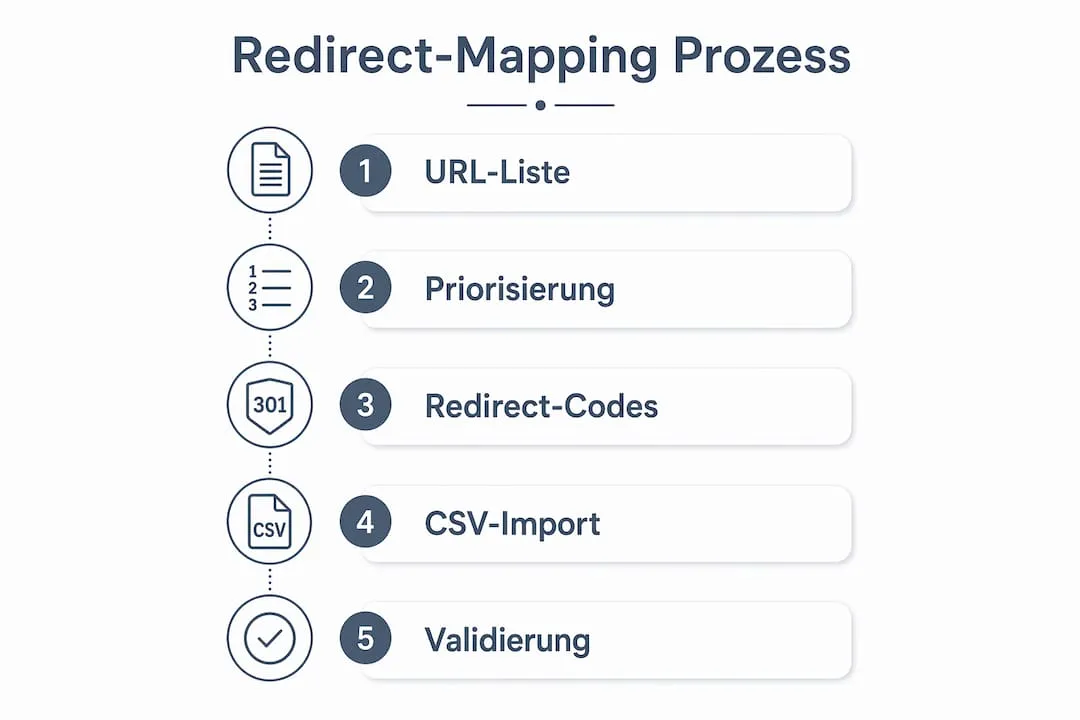
Redirect mapping is the technical core of every SEO-safe migration. Missing or inaccurate URL mapping is the most common cause of traffic losses after a relaunch. Every old URL must be mapped to exactly one new Shopify URL. If you want to dig deeper into why redirects matter so much during a migration, we’ve covered that in a dedicated post.
Step by Step to Complete Mapping
- Perform a complete crawl. Start Screaming Frog before migration and export all URLs with status codes, meta data and internal links.
- Understand Shopify URL structure. Shopify uses fixed URL patterns: products are under
/products/, categories under/collections/. An old URL like/categories/shoesmust redirect to/collections/shoes. - Create 1:1 mapping. Assign exactly one new target URL to each old URL. Avoid many-to-one mappings where multiple old URLs point to a single new page, unless pages are genuinely being merged.
- Define redirect type. Use exclusively 301 redirects. A 302 signals Google a temporary redirect and transfers no link authority.
- Upload redirects to Shopify. Shopify allows bulk import via CSV file in the “Navigation > URL Redirects” section.
- Check every redirect after go-live. Call up each old URL manually or via crawl and verify it correctly points to the new target URL.
Avoid Redirect Chains
Redirect chains slow down crawling and reduce transferred link authority. A chain occurs when URL A points to URL B and URL B points to URL C. Google does follow multiple hops, but each intermediate step costs signal strength. All old URLs must point directly to the final target URL, without intermediate stops.
| Situation | Recommended Solution |
|---|---|
| Old category URL | Direct to new collection URL via 301 |
| Already existing redirect on old platform | Check target URL, map directly to final Shopify URL |
| Deleted product page without successor | Redirect to parent collection page |
| Many similar product URLs | Map individually, no collective redirect to homepage |
Redirects should remain live for at least 1 year, ideally permanently. Google and external links need time to fully adopt the new URLs.
After importing your redirect CSV into Shopify, check with Screaming Frog whether redirect chains have emerged. Filter the crawl by status code 301 and verify the final URL is reached directly.
What Must You Consider with Domain Changes and the Change-of-Address Tool?
If you also change domains during migration, the Google Search Console Change-of-Address Tool comes into play. The tool signals Google a permanent domain change, but does not replace 301 redirects. Both measures must run in parallel.
Clear prerequisites apply for using the tool:
- Both domains must be verified in Google Search Console
- The 301 redirects from the old to the new domain must already be active
- Google checks redirect behavior during the validation process
- The tool is only available for root domains, not for subdirectories
The transfer phase lasts around 180 days. During this time, Google gradually adopts the new domain as the authoritative source. Rankings can fluctuate slightly during this phase. This is normal and not a sign of error.
Important: The Change-of-Address Tool alone does not protect against ranking losses. Only the combination of redirect mapping, Change-of-Address Tool and content consistency ensures a successful domain migration.
A common mistake is using the tool too early, before all redirects are correctly implemented. Google validates redirect behavior when using the tool. If redirects are missing or incorrectly set, validation fails.
How Do You Conduct Effective SEO Checks After Migration?
The post-migration check is not a one-time event. It is a continuous process that runs for at least three months after go-live. A complete SEO checklist for after your Shopify migration helps you not to miss a single step.
Daily monitoring via Screaming Frog, server logs and Google Search Console is the proven standard. Each of these tools covers different error sources. While you’re at it, verify that your canonical tags after the migration point correctly to the final Shopify URLs, otherwise you create duplicate content signals.
Your Post-Launch Monitoring Setup:
- Screaming Frog: Daily crawl of the new Shopify domain, focus on 404 errors and redirect chains
- Google Search Console: Weekly check of coverage, indexing errors and click development
- Server Logs: Analysis of which URLs Googlebot actually crawls and whether 404 errors occur
- Rank Tracking Tool: Weekly tracking of the most important keywords to detect ranking changes early
- Core Web Vitals: Monthly check of load times and user experience via Google Search Console
Set up an email alert in Google Search Console for new coverage errors. This way you learn immediately when Google discovers new 404 errors, without having to check manually every day.
An often overlooked aspect is AI visibility. SEO authority remains relevant for AI search systems too. Besides technical redirects, you need brand consistency across all channels so AI-based search queries correctly identify your shop. Ensure brand name, product names and descriptions remain consistent after migration.
If you see no significant ranking losses after 4 to 6 weeks, the migration went technically clean. Persistent losses after this period almost always point to faulty redirects or missing indexing.
What Common Mistakes Happen During SEO Migration to Shopify?
Most ranking losses after migration have the same causes. Knowing them helps you avoid them.
- Incomplete redirect mapping: Not all URLs are captured because the initial crawl was incomplete. Filter pages, pagination pages and old campaign URLs especially often fall through the cracks.
- Wrong redirect types: A 302 instead of a 301 transfers no link authority. Google treats 302 redirects as temporary and keeps the old URL in the index.
- Redirect chains: Often arise when redirects already existed on the old platform and were not cleaned up before mapping.
- Changed meta data without coordination: If title tags and meta descriptions are adjusted during migration without first checking the rankings of affected pages, well-ranking pages can lose relevance.
- No monitoring after launch: Many shop operators check the migration once and then switch off. But errors often only show up when Googlebot crawls the new URLs.
- Scaling problems with large catalogs: For shops with over 100,000 URLs, the redirect capacity of Shopify Standard accounts may not be sufficient. Those who don’t plan for this beforehand face an unsolvable problem after launch.
The central point remains: the most important ranking risk factor in migrations is the implementation of redirects, not the platform itself. Shopify is technically solid. What determines success or failure is the quality of the redirect setup.
What I’ve Learned After Over 45 Migrations
I’ve seen one mistake repeatedly in Shopify migrations: redirect mapping is treated as a one-time task you check off and forget. In practice, it’s a living document. New 404 errors appear because external sites link to URLs that weren’t captured in the initial crawl. Old campaign URLs that were active years ago suddenly show up again in the traffic report.
What really works is a systematic crawl test after go-live, where each redirect is checked individually. Regular technical audits and manual tracking of redirect chains are not a luxury, but mandatory. Those who skip this notice it at the latest after six weeks in rank tracking.
One aspect missing in many guides: AI visibility is becoming more important. If your brand name or product categories are named differently after migration than before, you don’t just lose classic rankings. You also lose the association in AI-powered search queries. Brand consistency is not a marketing topic, but a technical SEO topic.
My honest advice: plan the migration as if Google would manually check every single redirect. Because essentially, that’s what it does.
Gap-free redirect mapping and clean post-launch monitoring take time and experience. That’s exactly what we handle: we’ve migrated over 45 shops to Shopify without ranking loss. Request your free potential analysis
 Frequently Asked Questions
 What is a post-migration SEO check?
How long does it take for rankings to stabilize after migration?
Why is manual migration error-prone?
What happens if I don't clean up redirect chains?
Do I need the Change-of-Address Tool for every Shopify switch?
You might also like

How Important Are Redirects During a Migration?
Learn how redirects during migration protect your SEO value. Avoid traffic losses with effective strategies for platform changes and URL structure updates.

SEO Checklist After Shopify Migration: Secure Your Rankings
The SEO checklist after your Shopify migration: redirects, sitemap, canonicals and monitoring done right, so your rankings survive the switch.

What Role Do Canonical Tags Play in a Migration?
Learn how canonical tags protect your SEO rankings during migration. Expert tips on proper implementation and avoiding common mistakes that hurt visibility.